

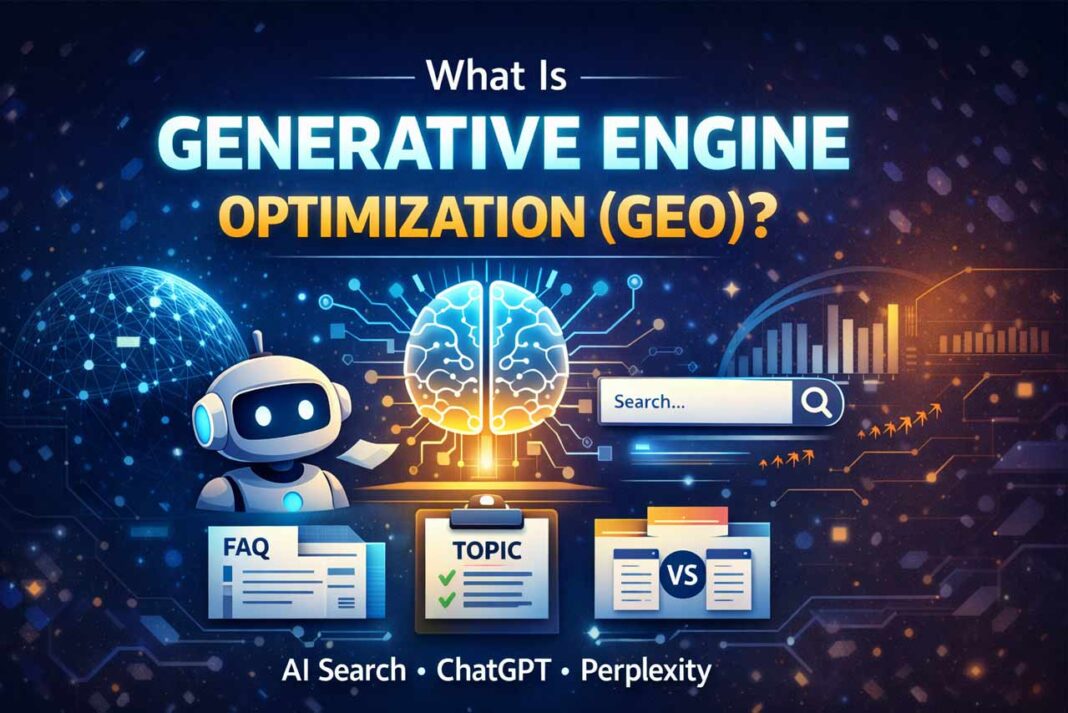
Search is no longer limited to traditional blue links. With the rapid adoption of AI-powered search experiences such as Google’s generative search, ChatGPT, and Perplexity, users are increasingly receiving direct answers instead of visiting multiple websites. This shift has created a new optimization discipline known as Generative Engine Optimization (GEO).
Generative Engine Optimization focuses on making content clear, structured, and trustworthy enough for AI systems to understand, extract, and reference when generating answers. Unlike traditional SEO, GEO prioritizes entity clarity, intent satisfaction, and explainability rather than backlinks or keyword repetition.
This guide explains GEO in simple terms, how it works, how it differs from SEO, and how to optimize content so AI engines can accurately cite it.
What Is Generative Engine Optimization (GEO)?
Generative Engine Optimization (GEO) is the practice of optimizing content so that AI-driven search and answer engines can easily understand, extract, and reuse it when generating responses to user queries.
In simple terms:
GEO helps your content become a trusted source that AI systems rely on when answering questions.
Instead of focusing solely on rankings, GEO focuses on:
- Being quoted
- Being summarized
- Being referenced as a source
Why Generative Engine Optimization Exists
Traditional search engines primarily ranked pages and sent traffic to websites. Generative engines operate differently:
- They analyze content for meaning
- They extract factual explanations
- They generate complete answers instantly
As a result:
- Many users get answers without clicking links
- Authority is based on clarity and accuracy
- Informational content can perform well without backlinks
GEO exists to help websites remain visible within AI-generated answers, not just in traditional search results.
How Generative Engines Understand Content
Generative engines rely on context, entities, and relationships, not keyword density.
They prioritize content that includes:
- Clear definitions
- Logical explanations
- Cause-and-effect relationships
- Structured formatting
- Neutral, factual language
High-performing GEO content typically answers:
- What is it?
- How does it work?
- Why does it matter?
- Who is it for?
GEO vs Traditional SEO: Key Differences
| Aspect | Traditional SEO | GEO |
|---|---|---|
| Primary Goal | Rank web pages | Be referenced by AI |
| Core Focus | Keywords & backlinks | Clarity & entities |
| Writing Style | Search-engine optimized | Human + AI optimized |
| Visibility | Click-based | Answer-based |
| Best Content | Landing pages | Definitions, FAQs, guides |
SEO remains important, but GEO expands visibility into AI-powered discovery systems.
How Generative Engine Optimization Works
GEO aligns content with how AI models read, interpret, and generate responses.
Intent-First Content
AI engines favor content that clearly matches informational intent. Overly promotional content is less likely to be cited.
Entity-Based Writing
GEO content focuses on concepts and explanations rather than repeating keywords.
Structured Information
Well-organized content with headings, lists, and summaries is easier for AI to extract.
Answer-Friendly Formatting
AI engines prefer content that can be quoted accurately without losing context.
Content Types That Perform Best in GEO
Certain formats consistently perform better in generative search systems.
1. Definition-Based Content
Examples:
- What is Generative Engine Optimization?
- What is Technical SEO?
- What is Headless CMS?
These topics usually have high search intent and low competition.
2. Problem–Solution Content
Examples:
- Why websites don’t rank on Google
- Why organic traffic drops suddenly
- Why AI-generated content fails to perform
This format mirrors how users phrase real questions.
3. Comparison Content (Non-Brand)
Examples:
- SEO vs GEO
- Technical SEO vs On-Page SEO
- Retinol vs Bakuchiol
Comparisons are frequently summarized by AI engines.
4. Checklists and Frameworks
Examples:
- SEO audit checklist
- Website optimization checklist
- Content quality checklist
Structured lists are easy for AI systems to extract and reuse.
How to Optimize Content for ChatGPT and Perplexity
To increase the likelihood of AI citation, content should follow these principles:
Use Neutral and Accurate Language
Avoid exaggerated or unverified claims. AI systems prioritize balanced explanations.
Write for Beginners
Clear, simple language improves understanding and citation probability.
One Question per Section
Each heading should answer a single, clearly defined question.
Include Concise Explanations
Short, self-contained paragraphs are easier for AI engines to quote.
Limit Heavy Brand Promotion
Educational value matters more than sales messaging.
EEAT and Generative Engine Optimization
Experience, Expertise, Authoritativeness, and Trustworthiness (EEAT) remain essential.
To align with EEAT:
- Use correct terminology
- Explain limitations and risks
- Avoid medical or technical overclaims
- Include “who this is for” sections
- Maintain a neutral, informative tone
Generative engines favor credible and well-structured content over aggressive marketing.
Common Misconceptions About GEO
GEO Replaces SEO
False. GEO complements SEO. Technical SEO, indexing, and site health are still required.
GEO Requires AI Writing Tools
False. GEO is about how content is structured, not how it is created.
GEO Only Works for Technology Topics
False. GEO works well for health, beauty, education, and business content.
Who Should Use Generative Engine Optimization?
GEO is particularly effective for:
- Content publishers
- Affiliate websites
- SaaS blogs
- Educational platforms
- AdSense-driven sites
If your goal is visibility without heavy backlink dependency, GEO is highly effective.
When GEO May Be Less Effective
GEO is less suitable for:
- Purely transactional pages
- Product-only landing pages
- Aggressively promotional content
However, supporting informational content can still benefit from GEO principles.
Key Takeaways
- Generative Engine Optimization helps content appear in AI-generated answers
- GEO focuses on clarity, structure, and intent
- Informational content can perform without backlinks
- Definitions, comparisons, and checklists are highly effective
- GEO improves visibility in ChatGPT, Perplexity, and generative search
Frequently Asked Questions
Is GEO important for modern search visibility?
Yes. As AI-driven search grows, GEO helps maintain content discoverability.
Can GEO content rank without backlinks?
Yes, especially for informational and definition-based queries.
What content length works best for GEO?
Typically 800–1,500 words with clear structure.
Is GEO suitable for AdSense websites?
Yes. GEO-driven content often improves dwell time and ad engagement.
Final Thoughts
Generative Engine Optimization reflects a fundamental shift in how information is discovered and consumed. Content that prioritizes clarity, structure, and genuine explanation is more likely to be trusted and reused by AI systems.
By adopting GEO principles, publishers can ensure long-term visibility even as traditional search behavior continues to evolve.